Setting Up International Business Infrastructure
Business Challenge
My international digital projects included paid contracts with foreign platforms, e-commerce sales on Amazon, and sales of digital products.
Working from Kazakhstan, I needed a legal and payment structure that could accept payments from abroad, pay contractors in several countries, and keep clear records for accounting and tax reporting.
My Role
I designed the entire structure and set it up myself, from company registration to day-to-day payment flows.
Approach
- Registered a US company (LLC), obtained a tax ID (EIN), and set up correspondence with the IRS.
- Opened a US business bank account as the company's main account.
- Set up an online checkout platform to accept payments for digital products.
- Opened a business account on a cross-border payout platform to receive payments from platforms and pay contractors, with a virtual card for infrastructure expenses.
- Opened a seller account on the Amazon marketplace.
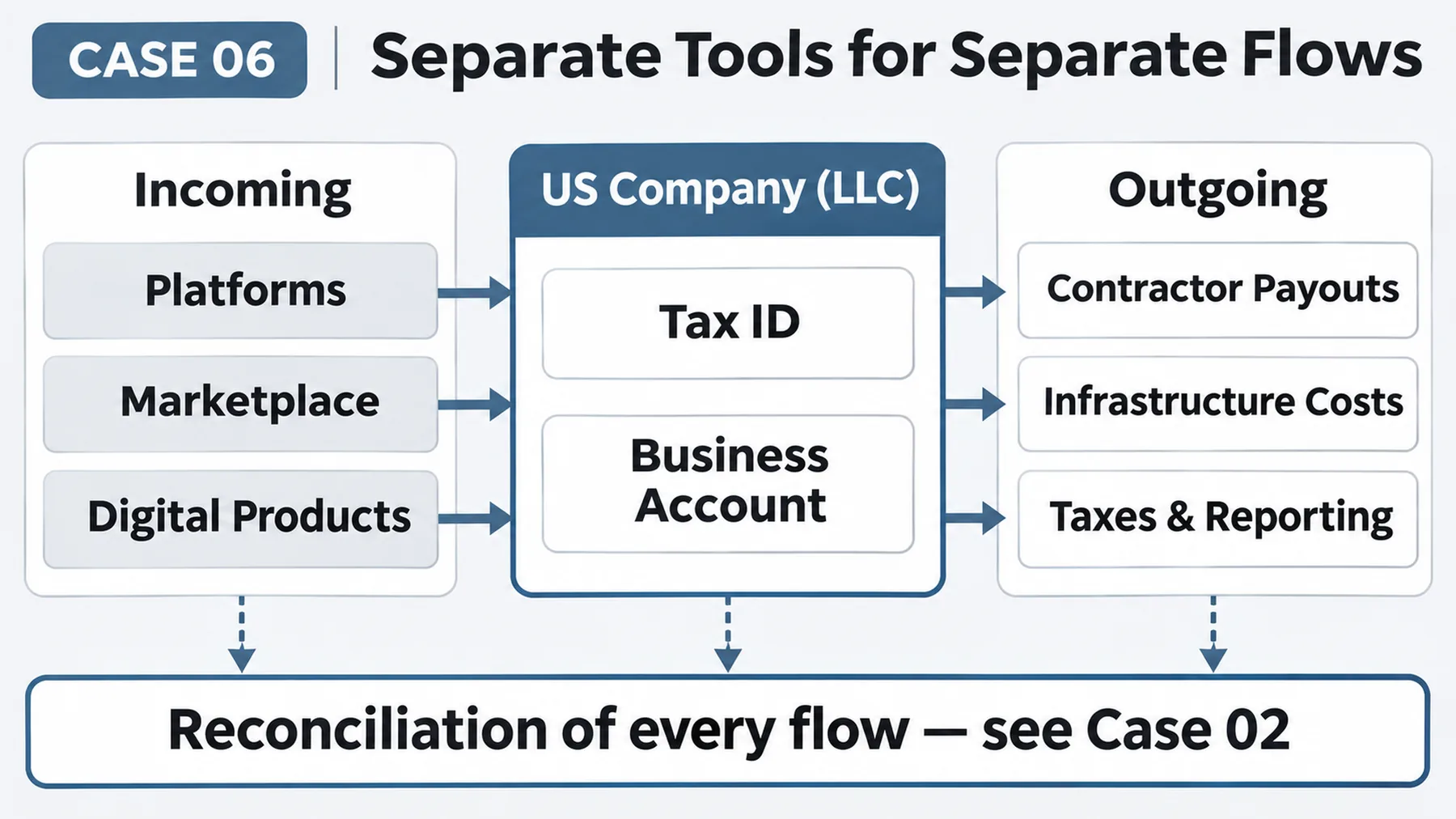
- Separated the flows by tool: incoming platform payments, contractor payouts, and infrastructure costs each went through their own channel, so every flow could be seen on its own.
- Built the structure before sales started, not after, and documented all access details and account information.
- Paid contractors in Indonesia, Thailand, Kazakhstan, and Russia in local currencies with exchange-rate conversion; reconciliation of incoming payments and payouts, including delayed and failed payouts, was tracked in Excel-based systems (see Case 02).
Outcome
The structure has been in use for several years: incoming payments from platforms and payouts to contractors in four countries go through it without a dedicated finance team.
Because each flow had its own tool, any payment could be traced quickly, and reconciliation stayed simple.