Building & Operating GPU Infrastructure (2017–2020)
Business Challenge
In 2017, I launched Bit-Planet News, an independent cryptocurrency project that combined GPU mining infrastructure with a news website and a Telegram community. This case covers the infrastructure side.
The challenge was to build and keep running a 24/7 hardware operation with a small team of assistants and without downtime, while keeping equipment and operating costs under control.
My Role
As the founder, working with a small team of assistants, I was responsible for planning, procurement, deployment, maintenance, and cost tracking.
Approach
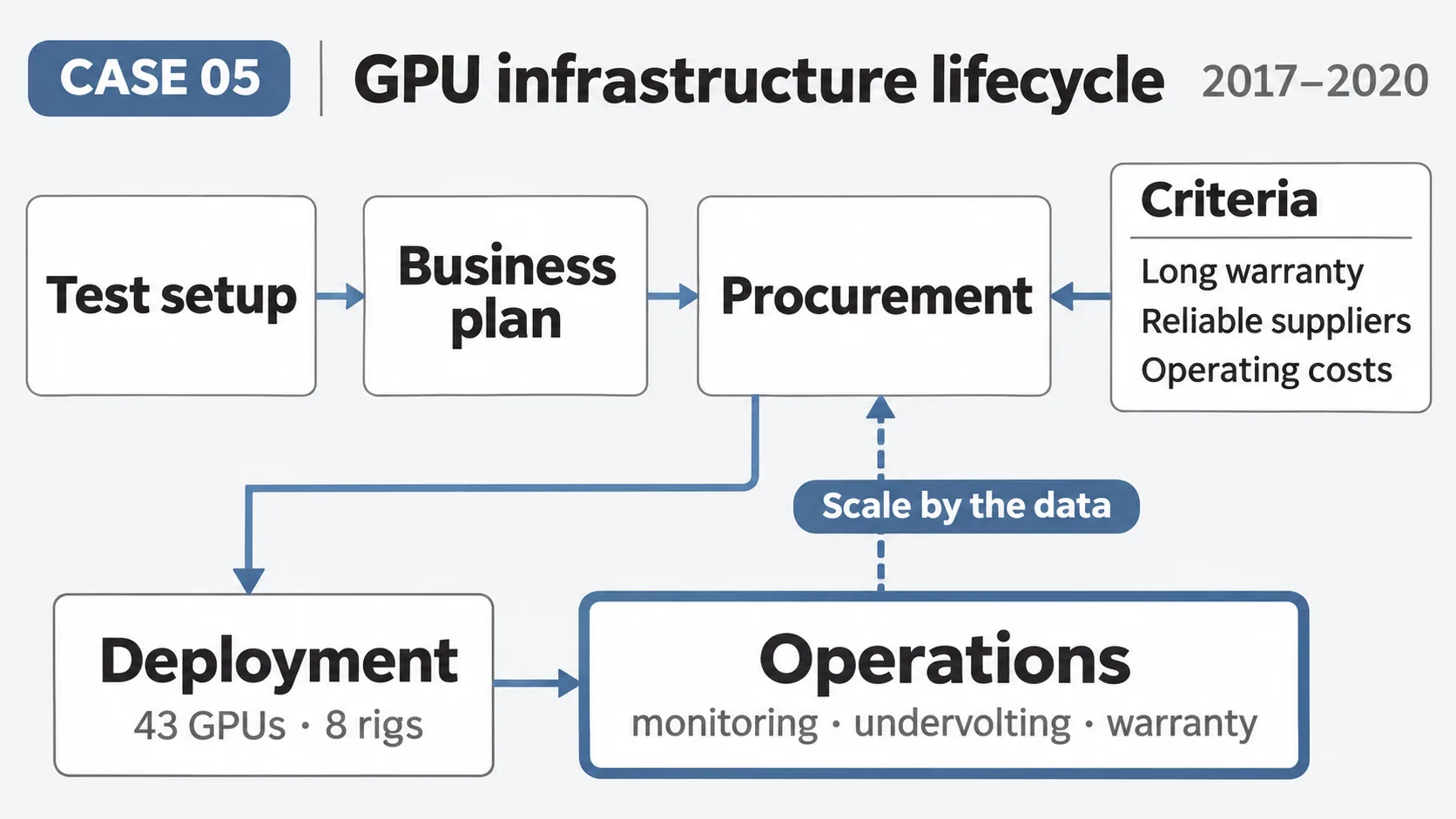
- Started with a small test setup of a few graphics cards to validate the economics before investing.
- Prepared a business plan and a financial model, then made a large-scale hardware purchase.
- Selected equipment with the longest available warranty, even when cheaper options existed.
- Managed suppliers of graphics cards, power supplies, and other components.
- Deployed 43 GPUs, mostly of one consumer model, across 8 rigs of 6–8 cards each, running a dedicated mining OS.
- Applied undervolting to reduce power consumption and heat.
- Monitored performance and profitability, and based expansion decisions on this data.
- Handled warranty repairs: one or two cards were usually under repair while the rest of the fleet kept running.
- Tracked operating costs, including electricity and maintenance.
Outcome
The infrastructure operated for three years, run by the founder with a small team of assistants.
The warranty-first procurement principle reduced repair costs: failed cards were repaired under warranty instead of at my own expense.
Revenue varied significantly month to month depending on market conditions.
From 2017 to 2020, the fleet of 43 GPUs ran around the clock, with usually only one or two cards out for warranty repair at a time.